There is way too much diversity of opionion around LLMs to plot on a simple "Pro-AI" to "Anti-AI" axis. The landscape of political positions and possible alliances is quite complex, rapidly shifting, and doesn't cleanly map to "left" and "right". I've seen several attempts to plot positions on 2 axes, but none of them quite captured everything. That's why I decided I need three axes. Behold: the Opinions Cube.
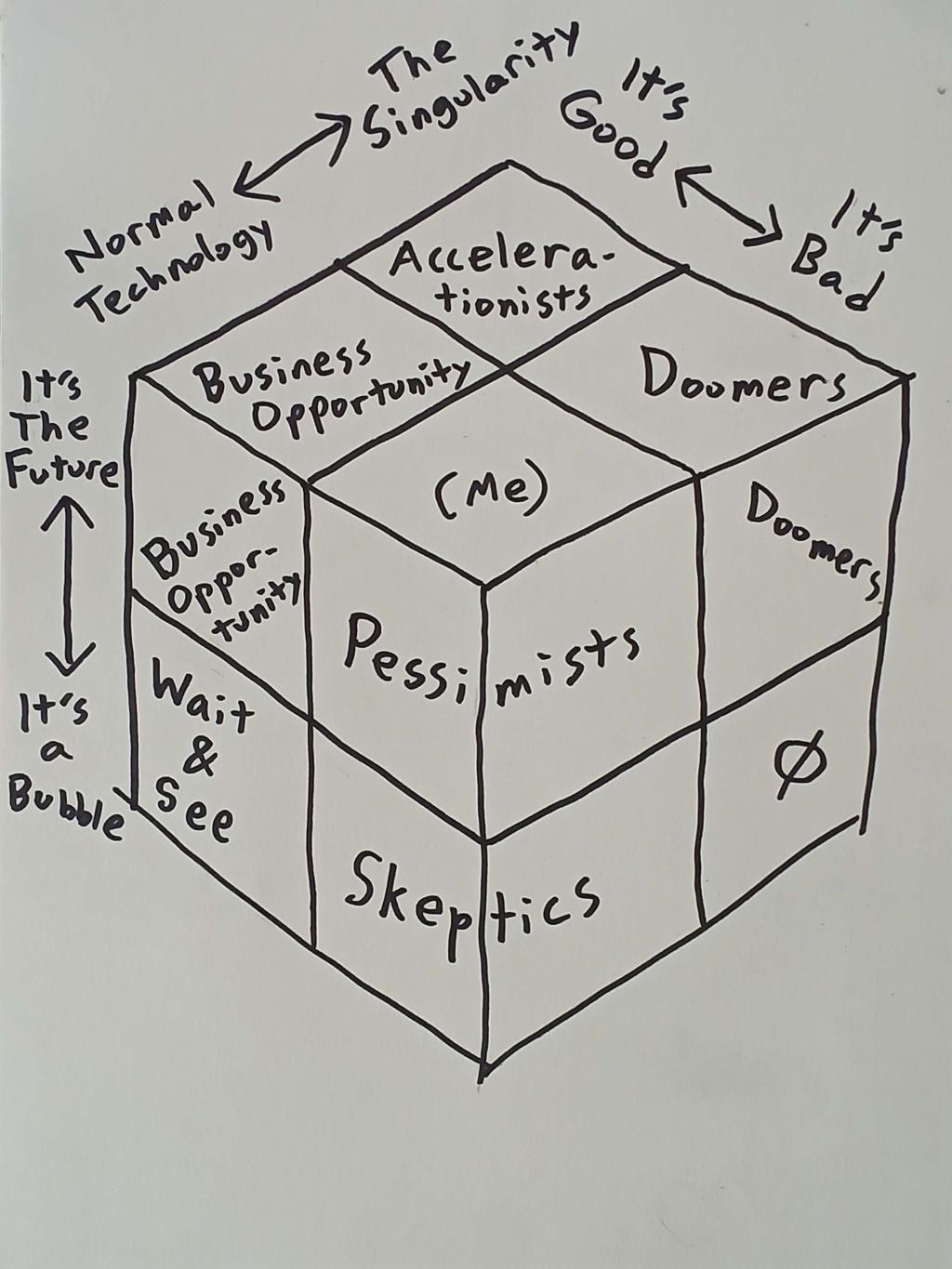
The bottom layer is "LLMs are overhyped, they can't deliver what's promised, we're in a bubble, it's gonna pop any day now". The top layer is the opposite of that - "LLMs are the future, for good or ill nothing's ever going to be the same"
Left to right axis is whether you believe the superintelligence hypothesis - the right layer is people who believe LLMs will become AGI and then get smarter than humans, in the near future, leading to some kind of singularity where humans become obsolete. The left layer is for people who are skeptical of this and analyze LLMs as "just a normal technology", albeit possibly one as big as the printing press or the internet.
Front to back axis is: do you finish this thought with "...and that's good" or "...and that's bad"?
The media likes turning everything into a two-sided conflict, so you'll see a lot of articles assuming a simple two-sided fight between Business Opportunists and Doomers, unable to conceive of or describe the many other important possibilities.
This multi-dimensionality of this space is why, for example, people protesting against a data center being build in their town find themselves in alliance with such strange bedfellows.
Skeptics
Front bottom, "no superintelligence, it's a bubble, and that's bad" -- this is the prediction that LLMs are going to end up being seen like NFTs or the Metaverse. People in this corner point out that most of the companies that have tried to adopt LLMs have found no advantage or found them making things worse. They point out the circular financing around NVidia, the overspending on data centers, the fact that the big LLM companies are going to need trillions of dollars in revenue just to break even. They predict a bubble pop, followed by a giant economic recession because so much investment is tied up in these risky bets. Ed Zitron and David Gerard are here.
A giant recession is bad, but a lot better than permanent world domination by an elite oligarchy of techbros or the replacement of the human species. So I consider these guys optimists. I hope they're right. However, they've been predicting the bubble will pop any day now for the past several years and they haven't been right yet, so I'm starting to lose hope.
Accelerationists
Exactly opposite is the Accelerationists, who think only good things are gonna happen. Superintelligence is just one or two more data centers away, and it's going to cure all diseases and make us all immortal and solve interstellar flight. Somehow. Through mechanisms nobody can explain.
What's preventing you from being an immortal galaxy-spanning god isn't basic physics or biology, it's just that human brains aren't smart enough to find the One Weird Trick. Luckily, intelligence is just a number, and you can just keep making that number bigger indefinitely, and the bigger you make it the more of your wishes it will grant. We're almost there, we just have to keep installing GPUs as fast as possible and do ever-bigger training runs.
Marc Andressen says the superintelligence will save millions of lives a month, therefore if you delay AI development by even one month (by requiring AI labs to follow laws, for example) it's equivalent to millions of murders.
If that sounds completely insane, congratulations! You are in touch with reality. The Accelerationists are always doing dubious moral calculus like that. They just make up some huge number of hypothetical future people, assert that a hypothetical future person matters just as much as a real person, and assert that they somehow know exactly what the effect of present-day actions on future people will be. They believe they're morally justified causing literally any amount of harm to actual people, in order to bring about the imaginary future utopia, because the future utopia outnumbers real people. "Nothing else matters because it's not as big as this really big number I just made up."
If it's not obvious, I think they're completely nuts. And these nuts include some of the most powerful people on Earth. Since we're currently spending trillions of dollars on data centers, I'd say these are the guys who are currently getting what they want. Which is terrifying. They're gambling our entire economy on what sounds like a complete pants-on-head fantasy world.
Doomers
The Doomer category also believes in superintelligence but thinks it's going to kill all humans. They're currently having A Moment in the mainstream media. Everybody this week is talking about the supposed "10% chance to make humanity extinct" that the Doomers believe in.
These guys are mostly members of the weird religion started by Eleizer Yudkowsky and propagated via Harry Potter fanfic. I've been following the development of this religion for over a decade now, but lots of people have just learned it exists and are now scratching their heads. Like the Accelerationists, they love argument-by-making-up-a-really-big-number. The only difference is that their fantasy AI God is evil, so the really big number is the number of humans it will turn into paperclips.
Amusingly, their preferred name for their religion is "Rationalism". You can't argue with a Rationalist because they reject empirical evidence and derive everything from first-principles, theology style. (Their favorite move is basically a version of Pascal's Wager.) If you challenge their claims, they can always prove themselves correct by just making up a bigger number.
Puzzlingly, lots of people currently working for OpenAI and Anthropic are Doomers. The rationalist religion tells them that the best thing to do with their lives is work for AI companies, even though they believe that the development of AI is hastening the end of the world. No, it doesn't make any sense to me either.
Doomers and I might be allies in wanting to stop the Accelerationists from building data centers, but our agreement ends there. I think they're a doomsday cult, their thinking is deeply confused, their analysis of the problem is not-even-wrong, and it's very counterproductive the way they're currently dominating the conversation about AI harms. Their imaginary harms are sucking all the attention away from discussion of the real harms.
Brief Politics Aside
There's an interesting thing happening right now where the Trump regime seems to be really gearing up for a fight against the Doomers. I haven't given the regime a position on the Opinion Cube, because I'm not sure they have enough brain cells to form a coherent thought about AI. (They love using it to generate misinformation, like propaganda images where The Glorious Leader looks muscular and heroic, but they don't understand what it is.)
Anyway, the regime is lashing out against the attention the Doomers are currently getting in the media. Possibly they see the Doomers as the biggest threat to the data-center bubble, and at some level they're dimly aware the data-center bubble is the only thing propping up the US economy right now, which is the only thing keeping their approval rating up in the mid-30s.
The Empty Corner
The bottom right corners (including the one at the back you can't see) represent "Superintelligence is coming, but it's overhyped" and I'm pretty sure nobody believes that. If you believe in superintelligence, there's no way it could be overhyped. If anything it's underhyped. These corners are therefore unoccupied. Moving on.
Pessimists
This is my corner. I don't believe in superintelligence, I think LLMs are basically a normal technology, I think they're bad in the way that normal technologies are often bad (like social media, and fossil fuels) and I'm pessimistic that there's any way to stop them.
This corner is not easily summed up with a single scenario. Unlike Doomers, Accelerationists, and Skeptics, we're not defined by a single confident prediction. We're not sure we know what's going to happen. Only that it's probably bad.
A common thread is that we tend to look at this mess from a pro-labor, anti-tech-oligarchy, class warfare perspective. LLMs are bad because the ruling class controls them and is using them as a weapon against the rest of us. The ruling class is the enemy, not some imaginary compu-god.
And also an environmental perspective. LLMs are bad because the data centers are powered by methane-burning plants that have reversed our progress against climate change.
I label our category "Pessimists" because we don't know what's going to happen, but we all notice that the billionaires are currently winning this class war.
Opportunists
At top left is what I think is the default view of the average casual ChatGPT user or the average mainstream news article writer: LLMs are a useful technology that will make business more efficient. They're a great opportunity to make money. (And help me cheat on my homework! Hooray! No downside.)
This category is full of LinkedIn bros: they ignore the superintelligence thesis but see LLMs as a huge opportunity to make money. They're the ones pushing slop into your feeds, convincing your boss that he needs to add a chatbot to your product, or using LLMs as an excuse to fire you. To the LinkedIn bro, LLMs are the greatest thing since the Internet, and since he probably missed his chance to get rich off of the internet, he is really hoping to get rich this time. He probably bought a lot of SpaceX stock on IPO day.
People have all sorts of different ideas about what exactly the opportunity of LLMs is, and how to take advantage of it. So there's a diversity of thought within this corner. There's coders attempting "hyperproductivity" using teams of "agents" that they "teach" coding "skills" to. There's people churning out a book a day and making a business of self-publishing on Amazon. There's people trying to merge themselves with AI and evolve into some kind of hybrid cyborg organisms.
I guess I kind of admire their spirit of experimentation, even if I think most of what they're doing is dumb and horrible, and it's taking away the jobs of people I care about, and it's making real human creativity harder to find by flooding the internet with slop.
Wait And See
The usefulness of exercises like this cube is that they sometimes help you discover a position nobody's talking about yet. The bottom, left, back corner seems like a contradiction: what does it mean to think LLMs are overhyped/in a bubble, but good?
I think there is a coherent position there, even if I can't think of anybody espousing it.
Something like: the LLM bubble is like the Dot-Com bubble. People did all this stupid shit with websites during the Dot-Com Bubble, they lost a lot of money, but the infrastructure it created was still useful, and after the dot-com bubble popped we eventually found the real, non-stupid uses for the web. We're currently in a bubble because people are using LLMs for all sorts of stupid things, things they're not good at. But after the bubble pops, then we'll eventually find the real uses of LLMs, which will be much better. And maybe less oligarchical.
I struggled to name this corner. I called it "Wait and see" because in this perspective, we're still too early to tell what the real uses of LLMs are going to end up being.
I'd be interested in reading more from this perspective, if I can find anybody arguing it. I think we could have productive conversation. Maybe they could convince me there's still hope for a possible future worth living in.
What Changed My Mind From Skeptic To Pessimist
In 2023 when ChatGPT-3 was new, I thought the threat to software engineering was somewhat overhyped. That wave of LLMs produced code that was often wrong in subtle but important ways. I thought people who tried to use it to replace coding would get burned badly enough to give up.
Also, LLM use was, and still is, heavily subsidized by investors willing to throw billions of dollars down a bottomless pit. Users are not paying the full cost of these things. Throwing billions of dollars down a bottomless pit is not sustainable, so someday users will have to pay what LLMS really cost; will it still be worth it then?
At that time, I was still optimistic that the bubble would pop soon and things could go back to normal. I was in the Skeptic corner.
We often confuse what we expect to be true with what we want to be true. People who think LLMs are terrible predict the bubble will pop and LLMs to vanish like NFTs and the Metaverse. People who think LLMs are good expect them to succeed. Not enough people are thinking about the third possibility: they're terrible, but we're stuck with them anyway. This is what I now think.
Two events changed my mind. First, DeepSeek, a cheap Chinese open-weight model, showed that it's possible for LLMs to be trained and deployed much more cheaply than the frontier labs are doing.
The second event is that around the end of 2025, there was a significant step up in the quality of code that LLMs like Claude Code could produce, to the point where it's no longer insane to consider putting an LLM-generated feature implementation into production after appropriate QA.
Because of these two facts, even if OpenAI and Anthropic perish as companies when the bubble pops, LLMs as a technology will, tragically, survive them. And its effect on software engineering is, tragically, not a fad. We're gonna be stuck finding a way to live with these awful things for the rest of our lives.
And that's why I'm now among the Pessimists.