The last few posts have been pretty heavy. Let me talk about something I enjoy for a change, so it's not all doom-and-gloom around here.
This meme was going around, I dunno, like last year or something: make a pick of 9 video games that were a big influence on you. Let's hop on the trend now that it's no longer relevant!
Keep in mind these aren't the 9 best or favorite games, just influential on me in some way.
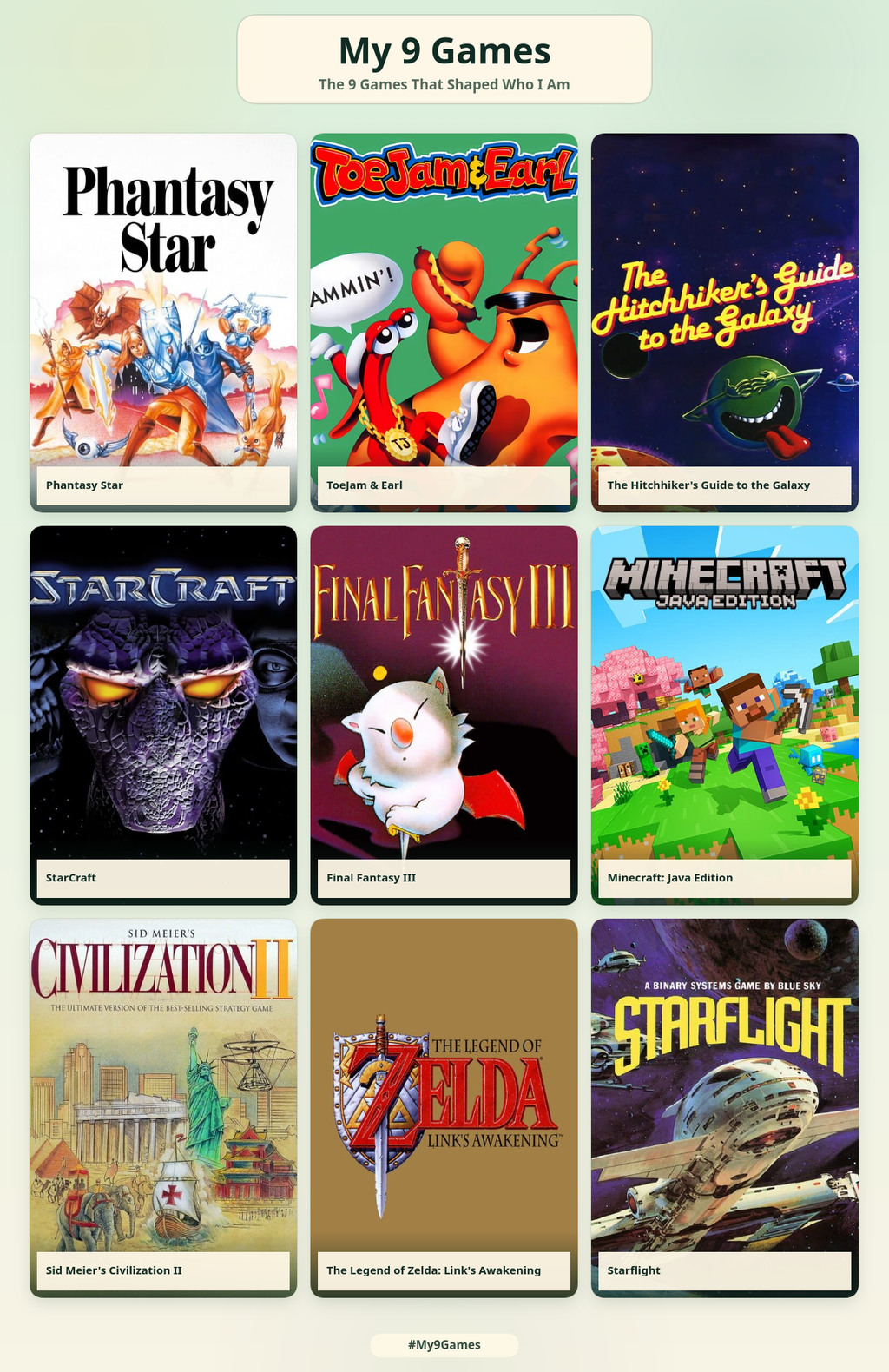
ToeJam & Earl (1991, Sega Genesis)
is what you get when you mash up a love of old-school hip-hop culture and funk grooves with a love of the procedurally-generated dungeon crawler Rogue, and make it a 2-player co-op Genesis game. Starring an alien rap duo from the planet Funkotron, who have crash-landed on Earth, and have to reassemble their spaceship to get home. The way this game made Earth a surreal place full of strange and hostile humans really resonated with me, a weird kid who felt like an alien most of the time. There is nothing else like it.
Not a lot of games had a co-op mode back in the 8-bit and 16-bit eras. Games that did really stood out. A lot of my best memories of this era come from playing 2-player co-op in ToeJam&Earl, Bubble Bobble, and Secret of Mana. Some of these games were, to be perfectly honest, kind of mid. But it's more fun to play a B- game with a good friend than play an A+ game alone.
I could talk about roguelikes or procedural generation but the lasting impact this game had on my life is musical.
Co-creator Greg Johnson talks about being inspired by Herbie Hancock, Parliament/Funkadelic, and Stevie Wonder.
As a kid I didn't know anything about the rich musical tradition this game was tapping into. I just knew it sounded like no other game before or since. Every level's track is an incredibly funky groove, it's banger after banger.
I guess it primed my brain because years later when I first heard a Parliament song I'm like "Whoa, this sounds like ToeJam&Earl, I need to hear more of this!". And that turned me on to the whole world of funk, soul, jazz, motown, fusion... Earth Wind & Fire, Sly & the Family Stone, Aretha Franklin, Nina Simone. This whole genre, or era, whatever you call it ( music historians have started retroactively labeling it "Progressive Soul") became basically my favorite thing ever.
Thanks, Greg Johnson! You seem like a really cool guy.
Phantasy Star - (1987, Sega Master System)
My family picked a Sega Master System and not a Nintendo, so my 8-bit nostalgia is a little different from most. Lots of people my age will walk down memory lane with you about Mario, Castlevania and Mega Man but when I mention Alex Kidd in Miracle World, Psycho Fox, or Wonder Boy 3 (my first metroidvania!) I get blank looks. We might not have had as many good games as the NES, but we did the best RPG of the 8-bit generation.
I had only ever played side-scrolling action games before, so I was initially very confused how to even play Phantasy Star. What's a save file? What's an experience point? What do you mean I have to wait for my turn to attack?
Sometimes JRPGs are too hand-holdy (and CRPGs are too directionless) but PS1 found a great balance. There's a clear goal (overthrow the goverment!), a female protagonist, three allies to recruit, three planets to explore, vehicles to ride in, and first-person dungeons to get lost in. There's dependencies, but the game never railroads you; you need to do your own exploration, trial-and-error, and piecing together of clues from NPC dialog, to figure out how to make progress.
Also if you step on the beach in the early game you get attacked by Fishman and die instantly. Don't do that.
It was my introduction to making maps on paper and writing down clues in a little booklet. You really had to map these dungeons or you'd be screwed. My family members (even my mom!) got into it and had their own save files, and we'd watch each other play and swap tips and discoveries. Felt like the whole game was a puzzle we're gradually solving together, as a group project. Took months to beat it.
Phantasy Star was a shockingly advanced game for 1987 - they got so much right on their first try. Later, when I played Dragon Warrior and Final Fantasy, they seemed like a massive step backwards: only one party member? no 3d dungeons? no moster animations? where are the pit traps, where are the encounters you can solve by talking why is there only one planet?
I wouldn't be the same person without my lifelong RPG and anime obsessions, and they both started here. (Phantasy Star 4 taught me what "manga" is)
Minecraft (2011, every platform)
The games I love most tend to be games where you explore a world, games where you build stuff, and games you play with friends. Like, combat is fine, story is fine, but what gets me excited are exploration, building, and co-operation. Guess what game is nothing but those three things cranked up to maximum?
In the manual to SimCity, Wil Wright talked about how SimCity was what he called a "software toy" rather than a game. A game has a victory condition, but a toy is open-ended; you can invent your own way of playing with it.
Minecraft is the ultimate software toy. An endless sandbox. An infinite supply of digital Lego. I started playing it online with my sister when it was still in beta, sometime in 2010 or 2011. It's now 2026 and I'm running a Minecraft server for my daughter and her friends. I can't believe the longevity this game has had. I got back into it and was astounded at all the cool new stuff they had added to the base game while I was away.
My sister was really shy in real life but she really came out of her shell when coordinating with other players on a Minecraft server. We used to play regularly as a way of keeping in touch despite living in different states. My daughter made a friend at a Minecraft camp last summer and now they're besties. This summer she did another Minecraft camp where she learned to program by writing a Minecraft plugin.
Minecraft really made me realize how much stuff in other video games feels like chores... obligatory fetch quests, gated progression, grinding, mandatory boss fights, unskippable cut scenes, linear story, etc. etc. etc. - now go here, now do this, now bring this thing to that guy... feels like work!
Minecraft is pure play. You just do whatever you want. There's some vague sense of progression, but you have to be the kind of person who easily comes up with your own goals. (The Ender Dragon? That wasn't added to Minecraft until after I'd been playing for a while, so I've always thought of it as just another optional achievement, not "winning the game")
And by the way, "Run your own server for you and your friends" is the ideal form of online multiplayer. Don't like the rules on one server? Make your own! Maybe if MMORPGs had worked like Minecraft instead of cramming everybody onto one server, they wouldn't have sucked.
Because of its open-ended nature and moddability, Minecraft has a huge fan-driven software ecosystem around it. Many mods these days are so extensive that it seems like Minecraft is more of a platform people use to create their own original games. Multiple generations of kids now have learned to do digital art to create texture packs, have learned to program to create mods, have learned leadership skills by organizing little online societies, and most of all have expressed their creativity through their crazy, crazy builds. What could be better than that?
Starcraft (pc/mac, 1998)
My intro to real-time strategy games was Warcraft 2, which was also the first game I played online. Playing Warcraft 2 online in those days meant typing in my friend's phone number so my modem could make a direct connection to his modem.
Starcraft promised to be even better, and it was maybe the most hyped I've ever been waiting for a game to come out. And it didn't disappoint.
The incredibly high skill ceiling and depth of strategic options make Starcraft (specifically with the Brood War expansion) one of the best strategy games ever. The three factions play extremely differently but none of them is the best; that means there's six matchups to learn. Every unit has its purpose, every tactic has its counter, and the counters have counters. A match between high-level competitors is a thing of beauty. So much space for player skill expression and creative surprise attacks.
To this day I understand a lot of concepts in strategy, multitasking, scheduling, and management by analogizing them to Starcraft in my head. I have a recurring stress dream where I'm playing SC and my economy is going great, but then I see a huge enemy army approaching and realize I somehow forgot to build dudes, my mineral count is floating, and I panic. That's how my asleep brain chooses to express the concept of "anxiety that I forgot something important".
I'm not a very competitive person, but Starcraft is the one exception. When Starcraft 2 came out, I got so into it that it started to take over my life. I was neglecting responsibilities to grind more games and increase my ladder rank. I would get angry at randos on the internet for beating me. I found out there was a part of myself that I didn't like very much, and I didn't want to feed that part. So for my own good, I quit cold-turkey.
I haven't played in many years but I still have all the keyboard shortcuts in my muscle memory.
The Hitchhiker's Guide to the Galaxy (PC/Mac, 1984)
One day, I was staying with some friends of my family, and they let me mess around on their new (Black & white) Macintosh computer. Remember computers before they were connected to the internet? You just had to entertain yourself with whatever programs you could find. And before the internet, you didn't really know what programs existed. Somebody else might have programs you'd never heard of. If you were bored, maybe you could find an art program and make a cool drawing. Maybe there were games hidden in a sub-folder somewhere. Maybe you'd find some oddball shareware program or a cool screen saver, like the one with the flying toasters.
Imagine my excitement when I found a program named after my at-the-time favorite book series. What's this? I had never heard of a "text adventure" before. This program is telling me I'm Arthur Dent and I can type whatever I want to do? What is going on???
It's not a very friendly introduction to adventure games. There's no king giving you a quest, nor is there a friendly white house with a mailbox. Instead the game starts in the dark because Arthur has his eyes closed as he struggles to wake up from a wicked hangover. (I just realized Disco Elysium swiped this opening.) If you wait too long a bulldozer smashes into your house, killing you.
In other words, most of the puzzles in The Hitchhiker's Guide to the Galaxy text adventure are Douglas Adams trolling the player in some way.
That's right, most licensed games are crap, but the Hitchhiker's Guide to the Galaxy text adventure was actually written by Douglas Adams himself. He was an early computer enthusiast as well as a sci-fi writer. This game is full of jokes, many at the player's expense, most of the jokes are good, and many of them are not in the book version.
Luckily the game has a very good built-in hint system - you can search for what you're stuck on, and it will progressively reveal hints starting with gentle nudges until you can figure the rest out for yourself. The hint system is the only thing that saves this game from being mostrously unfair and frustrating. I think all adventure games should have one like it.
Hitchhiker's Guide to the Galaxy led to my love of text adventure games, Infocom, the concept of interactive fiction in general, the Inform parser... it was the standard by which I judged all adventure games I played later, from Zork to Sam & Max Hit the Road.
(That's why I was extremely unimpressed when I played Myst. Its puzzles are too simplistic compared to the text adventures i'd already beaten.)
I still think about that puzzle where you have to have both Tea and No Tea at the same time. It's brilliant.
Final Fantasy 6 (Super Nintendo, 1994)
The picture above says "Final Fantasy III" because that's what the US box was labeled, but it was really Final Fantasy VI in Japan.
This was my introduction to localization changes, which caused the "original Japanese version" of games to take on a kind of mythic status in my mind. Why are there secret games that we don't get to play in America? Are those games so great that Japan is keeping them all for themselves and won't let us have any?
I built it up in my head that Seiken Densetsu 3 (the sequel to Secrt of Mana, which was Seiken Densetsu 2) must be the most amazing game of all time. Years later i finally played it on Japanese hardware and... it's OK I guess.
The skipped-over Final Fantasies were the reason I learned how to run emulators and download fan-translated ROM hacks from sketchy websites. They also sparked my interest in Japanese language media, an interest which eventually led me to get a job teaching English in Japan, which was kind of a big deal in terms of setting the course of the rest of my life.
Squaresoft in its 1990s golden age did some ambitious experiments in integrating gameplay and story together. For example, Final Fantasy 6 had this scene of diplomatic negotiation with your former enemies over a formal banquet, and the dialog choices you make can actually result in certain towns on the map being freed from the Empire or not. There's the courtroom scene in Chrono Trigger: character witnesses are called, and they report on things they saw your character do earlier, things you were not aware the game was tracking.
That suff was so cool! I was really excited for this as a direction the medium was going in, and I couldn't wait to see what they came up with next.
Well, it turns out Final Fantasy never quite achieved the game/story integration I was hoping for. In retrospect, those scenes were one-off gimmicks, not the harbinger of a new interactive medium.
The cost of AAA game development got so high that it became prohibitively expensive to make a bunch of content the player might not see. Even more so when games got voice acting. We'd have to wait for indie game designers decades later to pick this idea back up and run with it.
Instead, the ludonarrative dissonance just kept getting worse as the Final Fantasy series went on. FF6's story is about grief, about what happens when heroes fail and the world ends and then the survivors, who have lost everything, have to pick themselves up and find new reasons to go on living. But FF6's gameplay is about finding broken character/relic/esper combos that do 9999 damage.
I haven't played the Final Fantasy games after number 8 much. My taste has moved away from these super-long, cutscene-heavy, story-first style of games. When there's too many cutscenes and too much dialog it just seems like they wanted to make a movie instead of a game.
I could easily have put Chrono Trigger in this spot, or Secret of Mana, or a hipster choice like Final Fantasy V. I picked FFVI because... corny as this sounds, the story of FFVI is something that gives me strength when the world seems hopeless. As a teenager it was like "wow man so deep" but the story hits different after you're an adult who has experienced irreversible loss.
Link's Awakening (1993, Game Boy)
Breath of the Wild would be the Zelda game on my "Favorite games" list, but this is a "formative games" list, and Link's Awakening was the first Zelda game I owned, so I'm gonna talk about Link's Awakening.
This also gives me an excuse to talk about the Game Boy. The original, black&white (really more like "green and lighter green") Game Boy. The screen was tiny, you needed ideal lighting conditions to see anything, and you had to keep putting new AA batteries into it.
That thing sucked! But there were a bunch of cool games, like Metroid 2, that you couldn't play any other way.
My daughter is a big Kirby fan so I showed her the original black-and-white Kirby's Dream Land on Game Boy. She said she felt sorry for me. Nostalgia lies! Games really have gotten better. If you want to play Link's Awakening, play the Switch re-release.
There's two kinds of Zelda games: the gated-progress Zeldas and the open-world Zeldas. (Open-world Zeldas are my favorites but there's not many of them. The original Zelda 1, Breath of the Wild/Tears of the Kingdom, Wind Waker sort of?) Link's awakening is one of the best-designed gated-progress Zeldas. The map (Koholint Island, not Hyrule!) is an intricately crafted puzzle box. As you progressively unlock its layers, the way the whole thing fits together becomes clear, and it's very satisfying. I mapped it extensively on graph paper trying to find all the hidden seashells.
I really like the control scheme, the way you can map any item to either button and the sword and shield aren't special. I like the way Link's move-set expands, I like how whimsical everything is, I even like the weird side-scrolling sections.
The dungeon designs are great. This was the first time that the item you found in a dungeon changed how you played that dungeon. Seems obvious now, but it wasn't always. Dungeons like the Eagle's Tower are still some of Zelda's best. It's not just a series of rooms with puzzles and combat in them - it's more like the whole dungeon is one big machine, and you have to figure out how the machine works to understand what you need to do.
The first game I played with a sad ending, one that made me think "Wow the characters would have been better off if I had never finished the game. Maybe I, the player, am the real villain" which is such a cliche now.
Starflight (1986, computers, but I played the Sega Genesis port)
I love science fiction. Shocking, I know, you probably couldn't guess that from the fact that four of my 9 games are straight SF-themed and 2 more are SF/fantasy mashups.
Starflight is the science-fictioniest of science fiction games. Despite not being in the Star Trek universe, it's the most Star Trek experience you can have in a game. The cover art is by famed spaceship painter John Berkey, who illustrated countless classic SF novel covers. The game manual even contained a short story set in the game's universe by legit SF author Robert Silverberg.
It's not quite an RPG, not quite a simulation, not quite an adventure game, though it's got elements of all of those. The game mechanics are all downstream of the worldbuilding. It was one of the first games to use procedural generation (for planets), one of the earliest "sandbox" games... you could call it an ancestor of Mass Effect, Subnautica, and No Man's Sky.
You assemble a crew and customize a spaceship and then you head out to explore star systems. You can scan planets and tag them for possible settlement if they have the right atmosphere and gravity. You can land on most planets and go out in a little rover to mine minerals and capture wildlife. You can encounter several species of aliens, and your dialog choices determine whether they'll fight you, help you, or be neutral. (If you attack a species, other members of that species will remember you and treat you as an enemy. That's cool.)
You can upgrade your ship with all kinds of weapons and do ship-to-ship battle mode, but the risk was so high that I never found it worth it to fight anybody in my playthrough. I liked that you could win the game without fighting anybody. Maybe it's an ancestor of Undertale, too.
The worldbuilding is really cool! The alien species are memorable. There's an ongoing threat to the galaxy, which is revealed mainly by environmental storytelling - clues are found in the messages of derelict space probes and ancient ruins on planet surfaces. You can follow the trail of clues across the galaxy, or just fly around exploring and getting into trouble. Progress is entirely about player knowledge, not any kind of plot-flag gating.
Without any cutscenes or giant text dumps, Starflight makes you feel like a character in a golden-age science fiction novel. It's immersive because you're making the decisions that a starship captain would make in one of those books. It showed how a sandbox game can have a story in it without being limited by the story.
Civilization II (1996, PC/Mac)
Civ is torn between wanting to be a fun strategy game, and wanting to be a Single Unified Theory of History. The tension between these two things creates some fascinating gaps.
I remember as a teenager, being very confused about the fact that you can build a "Wonder of the World" named Women's Suffrage" - the way you'd build the Great Wall or Library of Alexandria -- and its effect is to act as a police station in every one of your cities. Why?
Is the game saying that women are inherently more likely to vote for increased police coverage? Of course not. It's just a gamey bonus because a wonder has to do something to help you in (but it's a Wonder, so no benefit for any country after the first to give women the vote...) and police stations put down civil unrest, increasing happiness.
Is it supposed to be like you civil unrest is retroactively defined as a suffragist movement and building Women's Suffrage appeases them? Wait, what are these resources we're spending to "build" it anyway? Don't I, the player, represent the male-only system of government that the suffragists are trying to replace? Am I spending resources on an attempt to overthrow myself? But even when my form of government says "Democracy", the people can never vote me out of office, I'm the player.
So who IS the player? Not any individual king or leader, because we can keep playing for thousands of years through many changes of system of governemnt. Who am I, that I have perfect information about my empire, and that my orders are carried out instantly by units on the other side of the world?
Isn't it weird that India is led by Gandhi in 2,000 BC? In real life Gandhi was never political leader of India, and in 2,000 BC there was nothing called "India" (there was a Harappan civilization located in an area that's now Pakistan). The player in Civilization is some kind of disembodied spirit of National Greatness for people of a certain ethnicity, which is a thing that has an unchanging essence reaching back into prehistory, which is why Abraham Lincoln, ruler of the American tribe, is trying to help them invent "The Wheel".
Think about what kind of person, in real life, thinks of himself as an expression of the eternal and unchanging essence of a certain ethnicity, treats individuals as insignificant pawns that can be pushed around the world map and sacrificed to expand borders in order to achieve Glory for The State, the only thing that matters?
I'm not saying Civ is a propaganda game or an authoritarian game or that it's responsible for real-world dictators being dictators, that's silly; but isn't it interesting that trying to make History into a Fun Game leads you to the same philosophy as authoritarian dictators, who very much see themselves as The Main Character Of History?
Why am I talking about all this? How is it connected to games influencing me? I think Civ was the first piece of media to really make me think about these contradictions, that's why.
Civ can't admit to itself that it has an ideology, but it absolutely does. Women's Suffrage is something granted to women by the wise and benevolent leadership of the nation when conditions become right for it, and it's mostly about the bragging rights of being the First Nation Where Women Can Vote rather than any change it would make to power. It's all part of the plan to achieve the real goal: conquering every other city in the world, or being the first to build an interstellar rocket.
Imagine an alternate game where progress is made by taking power away from the rulers of the state - forcing the state to submit to democracy, expanding the right to vote to more people, and using checks and balances to limit the ability of the ruling class to oppress me? Women's suffrage is a milestone because it doubles the number of people whose rights the state is forced to respect?
Thinking about the gaps and contradictions in Civ got me started asking questions, which led me to my own political philosophy. Although I ended up believing something quite opposite to the Civ ideology, I'm grateful to it for prompting the questions. Maybe it's more important for a work of art to make you think about the right questions than to offer the right answers.
Also it's really fun to play a 2-player co-op game of Civ and team up against the British Empire.
Honorable mention
If there was a tenth game it would probably be Mario Kart. It's not particularly a favorite series of mine but it might be the series I've played the most times with the most people across the most years. Got a lot of happy family memories built around it.
I realized I don't have a Metroidvania on this list, even though it's one of my favorite genres. But whatever, there's already a million essays on the internet about how brilliant Super Metroid was, you don't need me to write the million-and-one-th.